Last modification
Jump straight to the most important topics:
Summary
What do companies need to do now?
EmpCo-Checklist
Foundations, examples & practical recommendations
Webinar (On-Demand)
Credible, compliant communications with EmpCo and the UCA
From 27 September 2026, these requirements will be binding across the EU. The EmpCo Directive applies to companies of all sizes that communicate with consumers within the EU. This means that companies outside the EU, such as those in Switzerland, may also be affected. The aim of the directive is to avoid greenwashing and better protect consumers from misleading environmental and sustainability claims. For companies, this could result in far-reaching changes – from packaging and websites to marketing materials and public communications.
The EmpCo Directive will come into force across the EU on 27 September 2026. From that date, all affected companies must undertake adaptations to their communications to align them with the new requirements.
The EmpCo applies to all companies, regardless of the number of employees or turnover, that communicate with consumers within the EU, whether in writing, verbally, at public events, digitally or in print. This means that companies without a physical presence in the EU are also affected if their communications are directed at customers in an EU member state.
No transition period is currently planned. For companies, this means that statements on all communication materials (including packaging and websites) must be adapted by the deadline of 27 September 2026. An FAQ document from the European Commission emphasises that this also applies to packaging already on the market. Appropriate measures must be taken to ensure EmpCo compliance for these items as well, for example by placing notices or applying stickers.
The EmpCo Guidelines govern the communication of environmental and sustainability claims to consumers. They focus on three areas:
A sustainability seal is defined as a voluntary public or private seal of approval, quality mark or similar, which aims to highlight a product, process or business activity in terms of its environmental or social characteristics. Seals may only be used if they are awarded by the state or are based on a transparent, audited certification system. Company-owned labels or graphics that give the impression of being a label are not permitted.
The EU clearly emphasises that financing climate protection from companies remains possible and desirable. However, the financing of climate protection projects must be communicated accurately, transparently and in a verifiable manner. To this end, the following requirements must be met
Neutrality claims such as ‘climate neutral / climate-neutral’, ‘100% offset’ or ‘reduced carbon footprint’ are not permitted if they are based on emissions offsets beyond value chain mitigation. Such statements are only permitted if they are based on the actual impacts on the life cycle of the product in question (for example, in the form of reduction and decarbonisation processes).
The EmpCo Directive is implemented through national legislation in EU member states. Companies must align their communications with the adapted legal requirements in each relevant market. In Germany and Austria, the adaptations are incorporated into the Unfair Competition Act (UWG). In Switzerland, too, most of the changes have been incorporated into the UWG or are expected to be. They tighten the rules already in force and require companies to undertake adaptations of their communications, both in the digital and analogue spheres as well as in public appearances and presentations.
Both sets of guidelines have the same aim: to prevent greenwashing and ensure greater transparency in communication. However, they take a different approach:
The EmpCo Directive primarily regulates how companies may communicate with consumers and prohibits misleading or overly general statements.
The Green Claim Directive goes a step further in terms of content and is intended to specify how such claims must be properly substantiated – in other words, what data, methods and tests underpin them.
At present, however, the EmpCo Directive is the most relevant, as it has already been adopted and will apply from 2026. The Green Claim Directive is currently on hold politically and is not in force.
The EmpCo Directive introduces stricter rules, but at the same time offers opportunities for companies with a credible commitment to climate protection. The EU Directive is expected to lead to a consolidation of sustainability claims and environmental labels. It is anticipated that this streamlining of the market will both enhance the value of compliant communication tools and strengthen consumer confidence in your corporate commitment. The EmpCo Directive thus presents a clear opportunity for companies that pursue credible, high-quality climate protection, whilst free-riders face sanctions.
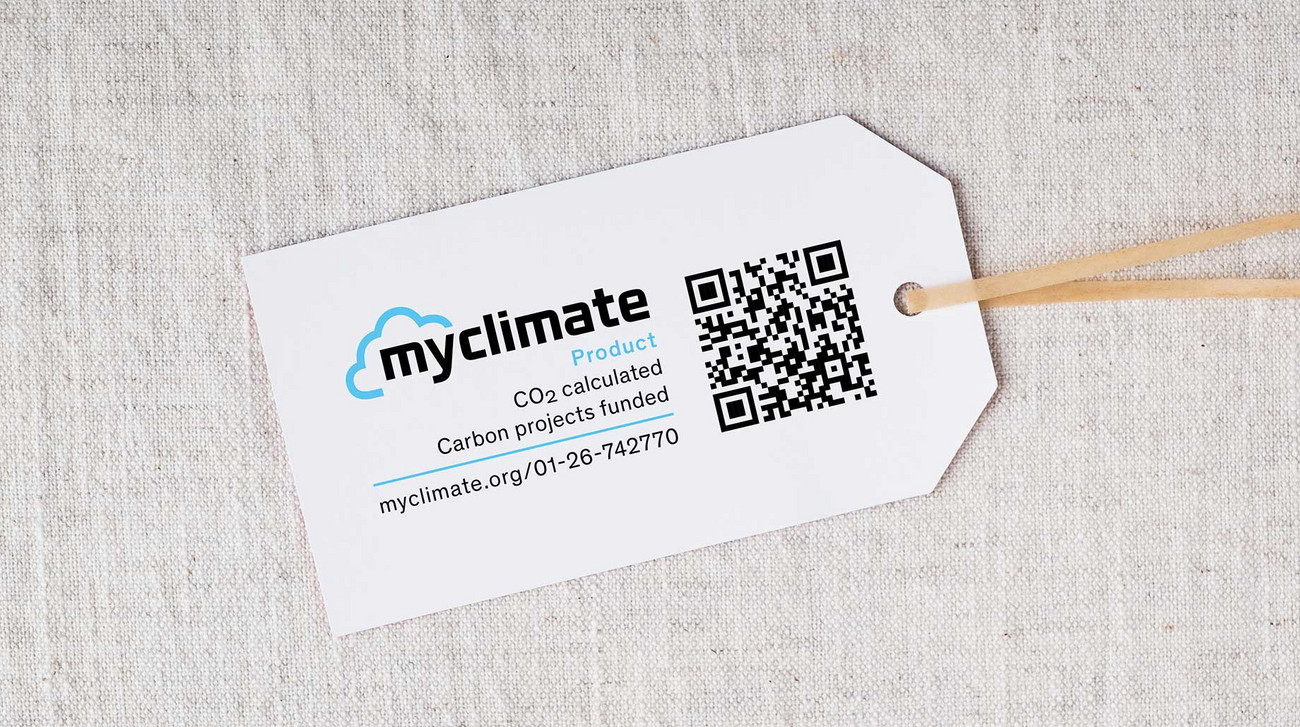
The myclimate label “CO₂ calculated – Carbon projects funded” is based on the myclimate Impact label and has additionally been aligned with the requirements of the EU’s EmpCo Directive. It combines a verified carbon footprint with financing for high-quality myclimate climate protection projects. A certification scheme and independent third-party verification ensure transparent and traceable climate communication. The label can be used in the EU/EEA and in Switzerland.
The myclimate Impact label is available for use outside Europe. It confirms that the CO₂ emissions of a company, product, service or event have been calculated and that high-quality myclimate climate protection projects are financed in a corresponding amount. In this way, companies take responsibility for the emissions they cause and make their commitment to climate protection transparent and visible.
Under the EmpCo Directive, companies will in future be required to provide clear evidence for their environmental and sustainability claims (green claims), formulate them precisely and communicate them transparently. Claims such as ‘climate friendly’ or ‘carbon-neutral’ are considered environmental claims and are subject to strict requirements regarding evidence and clarity.
A structured review of your own communications is the key first step towards EmpCo compliance. In practice, it often becomes apparent that individual statements, whilst well-intentioned, are not sufficiently substantiated or backed up by evidence.
To ensure a targeted approach, a structured method is recommended – from the initial assessment through to an in-depth analysis of specific use cases. Depending on your needs, myclimate offers three formats to support implementation:
Check your communications systematically against key criteria and identify typical risks at a glance.
Get a practical overview of the key requirements and see, through concrete examples, how companies are implementing the EmpCo Directive.
Watch the webinar
For a more in-depth, company-specific analysis, we also offer bespoke webinars. These sessions will discuss your specific questions, use cases and existing communication content within the context of the EmpCo Directive. Please contact us at:
communication@myclimate.org