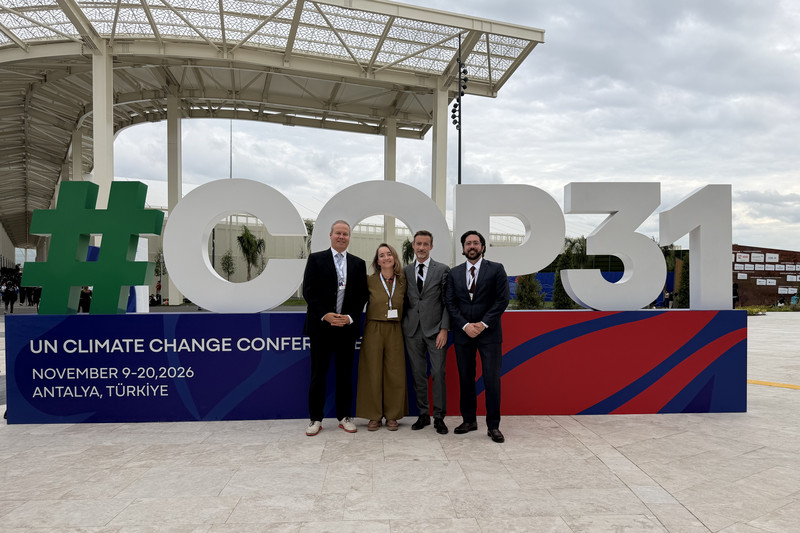
Part of the myclimate team on the ground at COP31 in Antalya, following developments around Article 6 and international carbon markets.
COP31 at a glance:
— COP31 ended without consensus on an overarching political outcome.
— With the frameworks increasingly in place, the challenge now is implementation. Article 6 needs an ecosystem that connects governments, project developers, financiers and buyers with the technical capacity and local expertise needed to deliver projects.
— International carbon markets nethertheless continued to move forward. Article 6 is increasingly shifting from frameworks and rule-making towards implementation.
— Governments are a core part of this emerging market infrastructure. Authorisation processes, national climate strategies and the capacity to implement Article 6 need to become practical priorities if projects and transactions are to scale.
— myclimate reached two concrete milestones at COP31: advancing its cooperation with Singapore and signing an MoU with Niger State, Nigeria, to explore further climate project development opportunities.
—For myclimate, this also means an evolving role: from developing high-integrity projects to increasingly connecting and coordinating the actors needed to move projects from potential to implementation.
Ahead of COP31, myclimate had already identified a structural shift in the international carbon market. Article 6.2 was creating new opportunities for bilateral cooperation linked to countries’ nationally determines contributions (NDCs), while Article 6.4 was taking shape as a broader United Nations (UN) crediting mechanism involving governments, project developers, buyers and other market actors.
Against this background, myclimate is working with other market participants around a more practical question: How will these markets work in practice, and who will make them work?
myclimate’s analysis from June 2026, led by our Article 6 policy experts Nsikan-George Emana and Paul Leon, had already identified this shift from rule-making towards implementation. It highlighted that the transition goes beyond replacing the CDM with new mechanisms: government decisions, authorisations, national climate strategies, supply, demand and project development are becoming increasingly interconnected.
At COP31, this transition was tangible across panels, bilateral meetings and conversations with governments, project developers, buyers and other market participants. At the same time, we observed a growing urgency to act, paired with strong demand for knowledge, technical capacity and practical guidance, particularly among early movers.
Our assessment after two weeks is therefore clear: there is real momentum, but implementation remains complex and uneven.
There is no single “Article 6 market”. Article 6.2 and Article 6.4 meet different needs, have different regulatory and operational designs and provide different approaches to international cooperation. Their implementation is therefore progressing at different levels and speeds.
Bilateral cooperation under Article 6.2 is becoming increasingly tangible. Governments are establishing partnerships and exploring how internationally transferred mitigation outcomes can contribute to their NDC targets and sustainable development strategies.
For myclimate, COP31 provided concrete examples of this development. Our cooperation with the Singapore Economic Development Board reached an important milestone, with myclimate establishing a local presence in Singapore to strengthen its Article 6 project development capabilities and deepen engagement with partners and market actors across Asia.
Another concrete milestone for us at COP31 was the signing of a Memorandum of Understanding between myclimate and Niger State, Nigeria. The agreement opens further opportunities for cooperation in project development, with the aim of translating investment interest into climate projects that also contribute to sustainable development in local communities.
Article 6.4, meanwhile, continues its transition towards operational implementation. Its emerging market dynamics depend not only on project development and buyer interest, but also on government decisions, authorisations, the ability to implement corresponding adjustments, and the integration of carbon-market activities into national climate strategies. Related compliance markets such as CORSIA add another source of potential demand, while also increasing the importance of regulatory readiness and eligible supply.
The new approach to crediting climate action is becoming clearer. However, across many conversations at COP31, one very practical question remained: Who moves first?
A recurring message from COP31 was that credible projects alone will not create a functioning international carbon market.
Governments need the capacity to establish authorisation processes and integrate Article 6 into national strategies. Project developers need clear frameworks and reliable partners. Buyers need confidence in credit and long-term regulatory certainty. Projects need financing, often years before the first credits can be issued. The capacity to validate and verify projects, access to technology providers and local expertise are equally important parts of this enabling environment.
In other words, implementation depends on an ecosystem in which these different actors and capabilities can come together.
The question is therefore increasingly shifting from “Do we have the rules?” to “Do we have the technical capacity, financing and partnerships to implement them?”
One topic stood out across very different COP31 discussions: integrity. But what does this really mean and how is it put into practice throughout the international carbon market ecosystem?
Robust monitoring, reporting and verification (MRV) remain fundamental. This was already one of myclimate’s central conclusions from COP30, where we stressed that credible MRV systems are essential for trust in carbon credits.
But the conversation is becoming broader.
At COP31, discussions repeatedly connected high integrity with strong safeguards, meaningful local participation, community rights, transparency and long-term sustainable development impact. These principles guide all our projects, as we strive to develop community-based activities, from cookstove projects to nature-based solutions (NBS). Successful projects often rely on relationships and trust with local communities that existed long before carbon finance entered the picture.
For project developers, this has an important implication: local participation and sustainable development cannot simply be added to a project afterwards as “co-benefits”. Embedding integrity in project design requires clear mechanisms, additional time and attention, and therefor comes at a cost. Yet it is essential to making a project credible and viable from the outset.
Governments shape how international carbon markets develop, and which types of activities are prioritised. Their role includes setting up the national framework for participation and deciding which activities can receive authorisation, in line with their climate and development priorities.
An important starting point is deciding which activities can be implemented under the conditional objectives of their nationally determined contributions (NDCs), where delivery depends on international support. These choices help determine where carbon finance can contribute and which activities governments want to advance through Article 6 cooperation.
Governments may, however, need support to translate these priorities into workable frameworks and project pipelines. Building government readiness requires technical expertise, institutional capacity and close cooperation with project developers and local partners.
This is where our work with Niger State in Nigeria comes in. Through consultations with state and federal institutions and assessments of potential project activities, myclimate will help explore how to translate the state’s green-economy priorities into viable carbon projects. This cooperation illustrates how technical support and long-term partnerships can help governments move from ambition towards implementation.
Shared infrastructure can also make it easier to establish carbon market. The international registry for Article 6.2 developed by the UNFCCC secretariat, together with its optional additional registry services, can help countries participate by providing infrastructure to track internationally transferred mitigation outcomes and support reporting. Access to these services can reduce the need for countries to build their own registry systems, helping them put the practical foundations for Article 6 cooperation in place.
COP31 reinforced a broader question for the market: As Article 6 moves towards implementation, how is the role of project developers changing?
Developing credible projects remains fundamental, but implementation increasingly depends on the ability to connect different parts of the ecosystem. Project developers need to navigate regulatory requirements, work with governments and local partners, understand buyer expectations, access financing and ensure that projects deliver credible sustainable development impact.
The role of project developers is therefore expanding beyond individual projects to connecting policy, finance, demand, and implementation.
For myclimate, this means combining our project-development experience with a broader role in bringing these elements together. Almost 25 years of experience in climate project development provide a strong foundation, but the emerging Article 6 market also requires closer cooperation across the entire ecosystem.
Our activities with Singapore and Niger State, as well as our continued work for the FOEN, provide concrete examples of what this can look like in practice: combining government cooperation, local market development, technical project expertise and long-term partnerships.
The task now is to translate these opportunities into credible projects and measurable climate impact.
COP31 did not provide simple answers to every question surrounding the future carbon market. But it reinforced the direction of travel. The frameworks are increasingly in place. Governments are engaging. New partnerships are emerging. Demand mechanisms are developing. And integrity expectations are rising, not falling. The next phase will therefore be shaped by those who can connect policy, finance, project development, local implementation and demand.
For myclimate, this is exactly where the work continues.