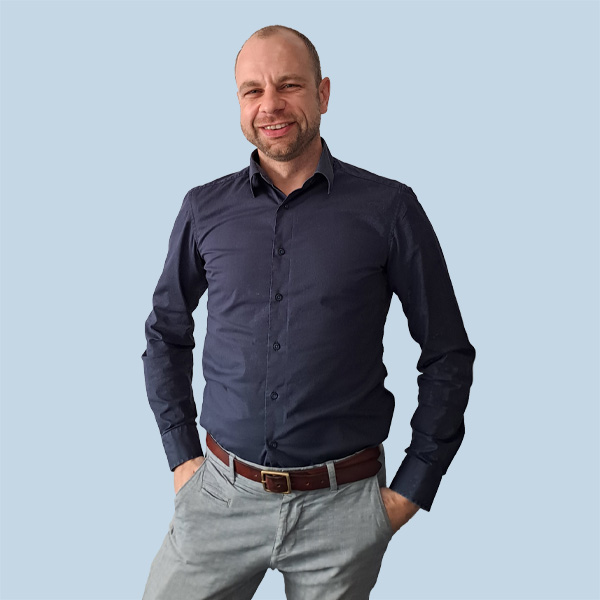
Dear Dirk, your sustainability report states “As GLS Bank, we bring money to where it is needed for a sustainable future”. What does “meaning” mean to you personally?
Dirk Kannacher: For me, meaning is everything that makes life worth living. That means both the present and the future. Human interaction is particularly important here: how we relate to each other, how we perceive each other, how we behave towards each other – all of that is important. I make sure that my actions make the other person feel good. That gives meaning to my life.
GLS Bank emphasises the meaning behind doing business. What makes GLS different from other banks?
The difference was already apparent when the bank was founded: it never wanted to simply be a bank. From the very beginning, it was about supporting meaningful social and ecological projects through different qualities of money. By money qualities, I mean the social levels that money has. We are talking here about buying, lending and giving. When I buy, I recognise someone else's service. When I lend, I trust the other person and when I give, I make something possible without expecting anything in return. All three qualities of money are needed for the economy to function. This is what our letters stand for: Gemeinschaftsbank für Leihen und Schenken – GLS. This is a fundamentally different approach to that taken by other banks.
Doesn't the logic behind it correspond more to wishful thinking than an economic approach?
No. Our mission statement states that purpose always comes before profit. THAT is the underlying logic of the economy: the division of labour was created so that people can concentrate on their talents. They create something in the world and receive a wage from which they can live. If economies were based on this, they would be self-driven and also become economically viable.
Your growth proves your idea right. But what does it take to scale this way of thinking in society?
Firstly, we need to change our education system. Let's please redefine the concept of the economy. In the order social, ecological, economic. The economy should serve people, within planetary boundaries.
I learnt the “normal” way of doing business. If you have to reprogramme that at the age of 38, you need a good mentor. I was lucky enough to find this mentor in the former CEO of GLS Bank, Thomas Jorberg. He sent me home again and again for three years and said: “You haven't understood this yet. You don't have the confidence that if you do something worthwhile, at the end of the day there will be someone who will pay for it.” As soon as we embed this realisation in education, things could change for the better very quickly.
What else needs to be changed besides education?
Economically speaking, almost everything will have to change. I like to see this historically in three phases.
Phase one was the time when intrinsically motivated people were already aware of the climate crisis. Their work resulted in the Kyoto Protocol signed in 1997, for example.
The second phase followed with the Paris Agreement. Here an attempt was made to give the commitment a treaty.
Now comes the third phase. I am convinced that this is the one that will convince everyone at the end of the day. In this phase, the risks of an economy without a focus on humanity become visible. This has even been recognised at the World Economic Forum in Davos. The Global Risk Report states that the greatest risks to economic growth in the coming years are extreme weather events and the climate crisis. These risks, which simply did not exist before, are now being priced in. If we act against people and nature, it simply no longer makes economic sense. This realisation is spreading. Climate protection, renewable energies and prevention are cheaper than doing nothing. The bet on fossil energy sources has run out.
On a scale of 1 to 100: how close are we to the goal of completing the third stage?
Difficult. I would say 60.
How do you live sustainability?
I am convinced that living sustainably does not limit me. On the contrary, it makes my life better and makes me much more satisfied, happier and healthier.
Keyword exercise: I try to do as many journeys as possible on foot or by bike. This means I cover around 5,000 kilometres a year by bike alone. As a side effect, I've lost five kilograms and feel biologically younger and fitter. A win-win for the climate and for me. The same applies to my clothing, diet and travel behaviour. There are many things I can adjust. I have decided all of this for myself personally and see it as a sensible lifestyle that allows me to do more for myself and our planet.
Does this also go down well with your family?
(Laughs): We had the discussion at home about whether my son should be allowed to buy a scooter or not. And at the end of the day, I came to the conclusion: I can only give a framework of values. Everyone has to decide for themselves which part of it they want to take with them. There is a quote that goes something like this: “You will find the right thing for yourself if I add something.” It's a different gesture and doesn't require any instruction. I simply add “something” without having to realise it exactly. Just because I've reached a different place in my life, I can't forbid it. I want to give my children the opportunity to “develop themselves”. In the end, he decided in favour of an electric scooter.
Last question: What is your call to all changemakers and managers?
Be honest with yourself! Only those who can lead themselves are able to lead others. And only those who are honest with themselves can become role models. If you ask yourself the question every day “What was your own responsibility in making the day a good one? How did you make sure that the relationships you were in during the day were good relationships?”, then you will notice how taking responsibility and “adding” your own thoughts and ideas creates something positive. I believe this is a fundamental question of attitude. If I may add a second statement, I would say: accept your limits and be happy.