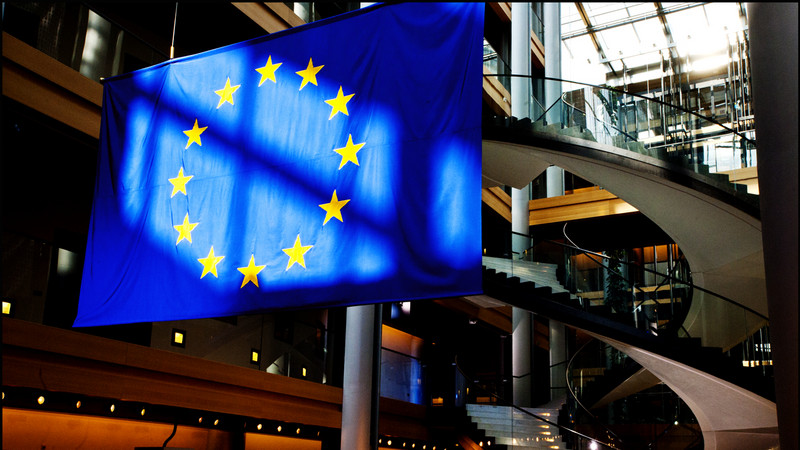
“The European Union flag in the European Parliament in Strasbourg”. Foto: European Parliament, CC BY-NC-ND 2.0
Update, 25 September 2026:
As expected, the Bundestag adopted the amendment on 24 September 2026. At the same time, the European Commission has amended its EmpCo FAQs, in particular Question 18.
In this, it addresses the specific situation in Germany and Austria, where organisations have the right to bring legal action and thus enforce the EmpCo. In this section, the Commission asks that the costs to companies and the environmental impact of destroying the products be taken into account before imposing penalties for infringements.
From 27 September 2026, the new provisions of the EU Directive ‘Empowering Consumers for the Green Transition’ (EmpCo) will apply in Germany. They significantly tighten the requirements for environmental and sustainability claims made to consumers. This affects, amongst other things, claims made on packaging, in advertising, on websites, in online shops and on social media.
According to information from the Bundestag, the governing parties are now planning to introduce a temporary transitional arrangement in the near future. This is intended to limit, for a period of two years, the ability to take action against certain EmpCo infringements relating to goods that were already placed on the market before the cut-off date. The decisive factor would therefore not be solely whether a product is still on the shelves on 27 September 2026, but whether it had already been delivered prior to that date.
According to Tabel.Briefings, the draft legislation provides that, in the event of potential infringements, courts must take particular account of the principle of proportionality. Among other things, the following aspects are to be taken into consideration:
the seriousness of the potential breach,
the efforts made by the company to remedy the infringement,
the costs associated with rectifying the breach, and
any potential environmental impact that could result from a recall, destruction or relabelling.
Should the regulation be adopted, it could ease the burden on companies with existing stock. This would be particularly relevant for physical goods and packaging produced or delivered before the cut-off date, where subsequent adaptations would entail high costs or additional environmental impacts. However, the planned regulation would not amount to a blanket free pass. Whether a company’s efforts are sufficient would have to be assessed on a case-by-case basis. Companies should therefore be able to document when goods were placed on the market, what adaptations have already been made, and why a complete correction of certain existing stock would be disproportionate.
“For companies with existing stock, the planned transitional arrangement could provide significant relief. However, it should under no circumstances be seen as a free pass. Consumer protection and environmental organisations, as well as competitors, will be watching very closely to see how companies deal with the new situation. It remains crucial to ensure that environmental and sustainability communications are now consistently aligned with EmpCo standards,” says Sven Focken-Kremer, Senior Manager Public Affairs & Strategic Communication at myclimate.
EmpCo also presents an opportunity to build greater credibility in the market. Companies that transparently substantiate their claims, use recognised certification systems and properly adapt their communications will have an advantage: “EmpCo-compliant communications will become significantly more visible and valuable in the market, whilst free-riders will find it difficult in future,” says Focken-Kremer.