Twinomujuni Jane Treasurer. Foto: Jjumba Martin
In brief:
There is scientific consensus that global climate protection urgently needs a comprehensive and ambitious combination of reduction and prevention measures on the one hand and the simultaneous promotion of international climate protection projects on the other. The Science Based Targets initiative, SBTi for short, as the world’s leading quality standard for corporate climate protection, has now updated its science-based approach in this regard. One aim of the new Corporate Net-Zero Standard is to also incentivised – and later demand – voluntary climate protection financing, as well as to reward it, and to ensure better traceability in order to achieve real positive impacts on the climate. It is open for public consultation until early December.
It draws on its report Above and Beyond, published in 2024, which concluded that companies need stronger incentives to act. The report suggested both formal recognition and credible communication as the most effective methods. The SBTi is now responding with its new proposal, which has already been preceded by an extensive initial public consultation. The SBTi’s compatibility with the 1.5-degree target and its commitment to achieving net zero by 2050 will remain in no doubt in the future. The use of carbon removals to neutralize the residual emissions remaining until a maximum of 2050 also remains an important part of the guideline.
Companies that take responsibility and invest in projects are rewarded
However, when calculating a company’s current carbon footprint, the SBTi is now fundamentally upgrading support for climate protection projects beyond the company’s own value chain (BVCM). For the first time, the SBTi is providing specific tools that companies can use before the net-zero target is reached if they already accept their Ongoing Emissions Responsibility and want to finance climate protection projects now.
In the future, companies should act in two ways:
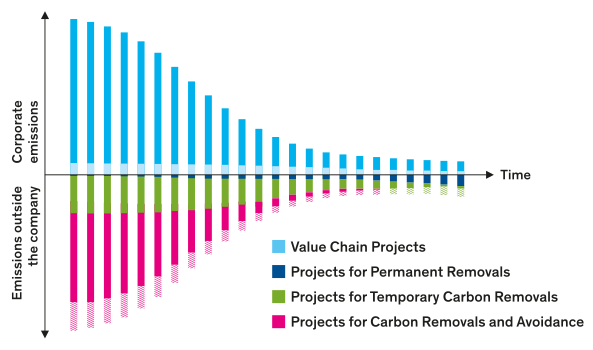
The new standard will now include what is known as a recognition model for climate contributions in the form of the Ongoing Emissions Responsibility (OER) framework. In doing so, the SBTi promotes the approach of companies that are prepared to strategically link long- and medium-term reduction and avoidance measures with carbon-cutting and reduction projects that are effective in the short term, in order to make a significant contribution towards achieving the global 1.5 °C target. This will make the best possible use of the time until these ambitious targets are achieved and will contribute to net zero for society as a whole. The graphic shows what this approach might look like in practice.
The new Corporate Net-Zero Standard
In addition to introducing the “Ongoing Emissions Responsibility framework”, this standard places a stronger focus on linking short-term measures with long-term climate targets than the first version and requires the publication of specific transition plans. In addition, the requirements for setting targets for each scope are differentiated and more specific to take account of the different challenges and decarbonisation levers. What is also new is that companies will be given more flexibility to adapt their measures to their own framework conditions and to focus on the most important sources of emissions. Finally, the standard places greater emphasis on transparency in measuring and reporting progress to ensure credibility and continuous improvement.
The timescale for the new Corporate Net-Zero Standard
Companies can continue to set short-term and long-term climate targets, and have them validated, as part of the Corporate Net-Zero Standard 1.2 until the end of 2027. They also do not have to fear that achievements already accomplished will be for nothing. The SBTi is providing a transition pathway to ensure that the transformation proceeds smoothly. Targets validated before 2025 remain valid until 2030 or until the end of the declared time frame, depending on which occurs earlier. From 2028 on, all new short-term and long-term targets will then be set in accordance with the Corporate Net-Zero Standard 2.0.
What companies should do now
How myclimate supports your company
myclimate advises and supports companies on their path to net zero. We also use our expertise to help partners when they commit to the SBTi and set targets and reduction pathways. In recent years, the SBTi has succeeded in creating a credible, ambitious and attractive framework for companies that want to lead the way in an environmentally sustainable economy. The new version of the standard makes a company’s investments in climate protection projects outside its own supply chain more relevant. As a project developer with more than 20 years of experience, we can provide climate protection financing tailored to your business environment and to the SBTi target set.