Foto: myclimate
Whenever I walk through woods or speak to farmers these days, one thing becomes particularly clear: the consequences of climate change have long been a reality. Parched soil, trees shedding their leaves as early as August, forest fires even in our regions, and increasing extreme weather events show that we must do more than simply reduce emissions. We must also make our landscapes more resilient to the effects of climate change.
Every day, I grapple with the question of how we can strengthen ecosystems so that they can continue to fulfil their vital functions even under changing climatic conditions. After all, healthy forests, soils, peatlands and water bodies are far more than just beautiful natural spaces. They store water, promote biodiversity, regulate the local climate and form the basis for sustainability in food production.
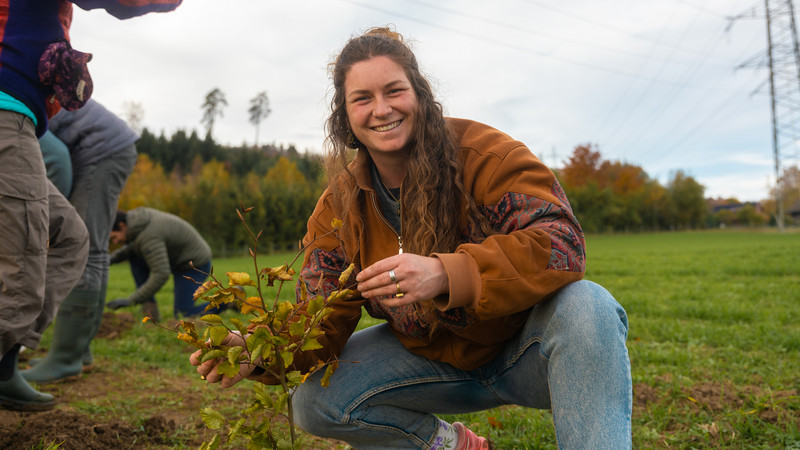
I see particularly great potential in nature-based solutions such as agroforestry systems. These involve the targeted integration of trees into agricultural land. Trees store carbon from the atmosphere and thus make an important contribution to climate protection. They provide shade, can lower temperatures on agricultural land by 2 to 4°C, reduce evaporation and improve soil quality in the long term. The differences become increasingly apparent, particularly during hot and dry summers, as whilst unprotected areas dry out more quickly, areas near rows of trees often remain green and productive for longer. At the same time, agroforestry systems create habitats for numerous animal and plant species. All of this can make agricultural land and farms more resilient to the effects of climate change, such as heatwaves and drought, and help to reduce crop failures as well as the risks of rising food prices and supply shortages.
Our forests also play a crucial role in climate protection AND in adaptation to climate change. Many forest stands are already suffering from drought stress, storm damage or pest infestation. That is why we support projects that promote the development of diverse and climate-resilient mixed forests. Such forests are better able to undertake adaptation to changing conditions whilst making an effective and important contribution to climate and nature conservation. In this way, the fundamental functions of forests for our society can be preserved, restored and specifically promoted. In addition to carbon sequestration, these include the protection of biodiversity, the regulation of the water cycle and protection against natural hazards. Climate-adapted forests, for example, are better able to cope with water scarcity. Different tree species have roots of varying depths and react differently to drought. As a result, they utilise available water supplies in different ways, reducing the risk that the entire forest will suffer from drought stress at the same time. In this way, diverse, site-appropriate forests remain more resilient even during prolonged periods of heat and drought.
Peatlands also play an often underestimated yet crucial role. For decades, they were drained for agricultural or forestry use. This not only led to the loss of valuable habitats; it also impaired their function as natural carbon and water reservoirs. Intact peatlands can retain large quantities of water in the landscape and influence how quickly rainwater is released. In this way, they help to regulate the landscape’s water balance and can – depending on their location and type – also mitigate peak runoff. Although they cover only around 3 per cent of the world’s land area, they contain more carbon than all the world’s forests combined. When peatlands are drained, this carbon – accumulated over millennia – is broken down and released as a greenhouse gas. Projects that promote the rewetting of peatlands therefore help in two ways: they prevent further emissions whilst at the same time restoring vital functions for the water cycle, biodiversity and the resilience of ecosystems to the effects of climate change.
However, the effects of heat and water scarcity do not only affect agriculture or forestry. They have an impact on our entire society. When harvests fail, food prices rise and animal feed becomes scarce. When rivers carry too little water, transport routes are disrupted. Homes and entire villages have to be evacuated due to forest fires. Increasingly frequent heatwaves are taking a toll on the health of many people.
That is why I am convinced that nature-based solutions are one of the most effective investments in our society’s future. They combine climate protection and climate adaptation, strengthen biodiversity and help to conserve natural resources in the long term. At the same time, they create more resilient landscapes, the functions of which not only benefit us all, but on which our livelihoods and well-being also depend.
The challenges are great. And the opportunities are just as great, provided we make the right decisions today. Every new row of trees planted in an agroforestry system, every converted mixed forest, every rewetted peatland and every measure to strengthen healthy soils is a step towards a more resilient future.